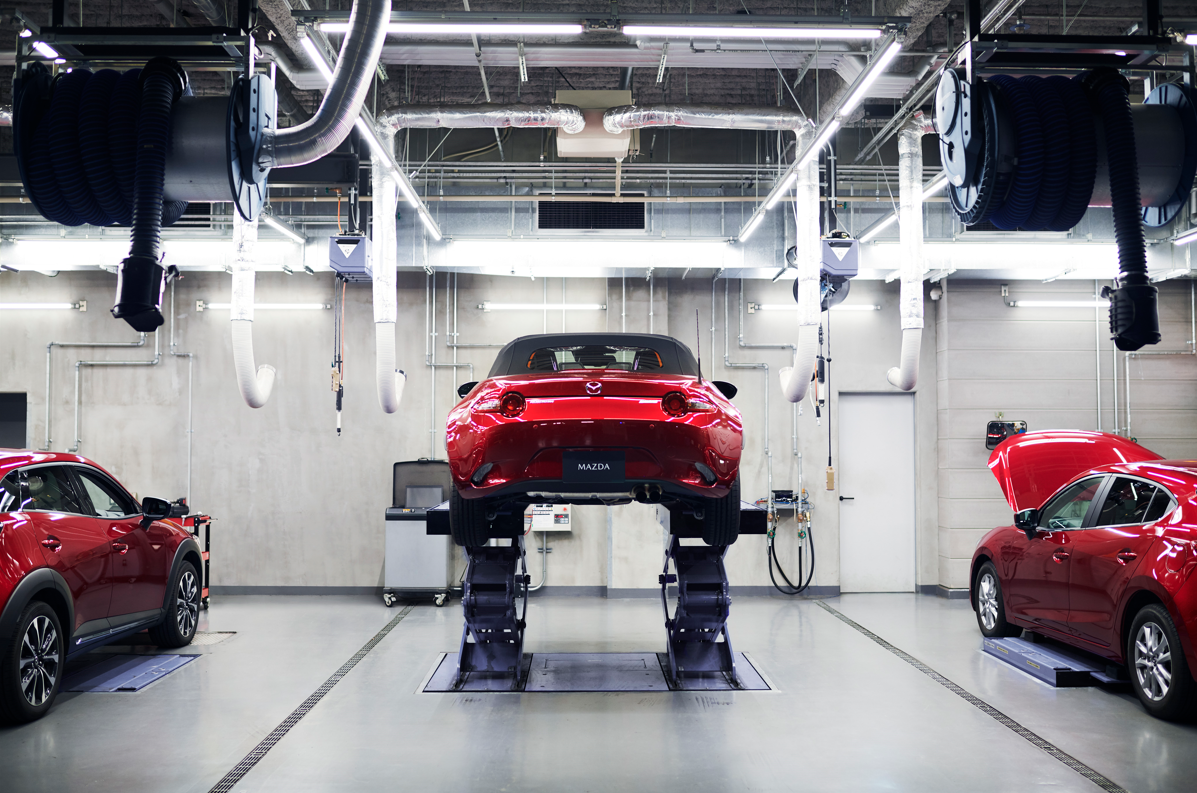
Wheel Alignment Service in Monroeville, PA
Proper wheel alignment is one of the most overlooked — yet most important — aspects of vehicle maintenance. When your wheels are correctly aligned, your Mazda handles predictably, your tires wear evenly, and your fuel economy stays where it should be. When alignment is off, even slightly, the effects compound over time: tires wear out prematurely, your vehicle pulls to one side, and your steering feels less precise. At #1 Cochran Mazda Monroeville, our certified technicians use computerized alignment equipment to bring your Mazda's suspension geometry back to factory specifications, helping you get the most out of every mile on the roads of Monroeville, PA and the greater Pittsburgh area.
What Wheel Alignment Actually Means
Wheel alignment refers to the precise angles at which your tires make contact with the road. These angles are set by your vehicle's suspension system and are engineered to very specific measurements by Mazda for each model. When all four wheels are properly aligned, they point in the same direction, roll parallel to each other, and sit perfectly perpendicular to the road surface. The result is a vehicle that tracks straight, corners confidently, and distributes wear evenly across all four tires.
Alignment is measured using three primary angles. Camber is the inward or outward tilt of the tire when viewed from the front — too much tilt in either direction causes one edge of the tire to wear faster than the other. Toe describes whether the fronts of the tires point inward (toe-in) or outward (toe-out) when viewed from above — incorrect toe is the most common cause of rapid, feathered tire wear. Caster is the angle of the steering axis when viewed from the side, which affects steering feel, straight-line stability, and how the vehicle returns to center after a turn. Our alignment equipment measures all three angles simultaneously and compares them to Mazda's precise factory specifications for your model.
Common Causes of Wheel Misalignment
Wheel alignment doesn't go out on its own overnight — it's usually the result of specific events or gradual wear on suspension components. In western Pennsylvania, there are plenty of opportunities for your alignment to take a hit. Here are the most common culprits:
- Potholes — Hitting a pothole at speed is one of the most frequent alignment disruptors. The sudden, sharp impact transfers directly to your suspension and can shift alignment angles measurably in a single strike. Pittsburgh-area roads are notorious for their pothole population, especially in late winter and early spring.
- Curb strikes — Rolling into or over a curb — even slowly in a parking lot — can knock your alignment out of spec, particularly in the front wheels. It doesn't take a hard impact to cause a measurable shift.
- Minor accidents and fender-benders — Even low-speed collisions can move suspension and steering components enough to affect alignment angles. After any impact, an alignment check is a smart precaution.
- Worn suspension or steering components — Tie rod ends, ball joints, control arm bushings, and struts all wear over time. As these components develop play or deteriorate, they allow alignment angles to shift gradually. In these cases, the worn parts must be replaced before an alignment can hold.
- Normal wear over time — Even without a dramatic event, alignment can drift gradually with age and accumulated mileage. Springs sag slightly, bushings soften, and mounting points shift imperceptibly — all of which can add up to a meaningful alignment change over the course of a year or more.
Signs Your Mazda May Need a Wheel Alignment
Your Mazda will often signal that its alignment needs attention before the problem becomes severe. Pay attention to these warning signs and bring your vehicle in to #1 Cochran Mazda Monroeville if you notice any of the following:
- Vehicle pulling to the left or right — If you have to constantly correct the steering wheel to keep your Mazda traveling straight on a level road, your alignment is likely off. The pull will follow the direction of the misalignment.
- Steering wheel off-center — If your steering wheel is noticeably tilted to one side when driving straight, your alignment needs to be checked and corrected.
- Uneven or rapid tire wear — Inspect your tires regularly. If one edge of a tire is wearing faster than the other, or if you notice a feathered or saw-tooth pattern across the tread, alignment is usually the cause.
- Loose, wandering, or vague steering — A properly aligned vehicle tracks predictably and requires minimal input to maintain a straight line. If your Mazda feels like it drifts or wanders, or if the steering feels less precise than it used to, alignment may be contributing to the problem.
- Vibration in the steering wheel — While steering vibration can have multiple causes, misalignment — particularly in the front wheels — can create a vibration that's most noticeable at highway speeds.
The Real Cost of Ignoring Wheel Alignment
Misalignment might seem like a minor inconvenience, but the financial and safety consequences of ignoring it are significant. When your wheels are out of alignment, your tires are constantly fighting against the direction of travel rather than rolling cleanly with it. This creates friction and scrubbing that accelerates tread wear dramatically — a set of tires that might last 50,000 miles with proper alignment could wear out in 20,000 or fewer miles if alignment is significantly off.
Beyond tire wear, misalignment puts additional stress on steering and suspension components. Ball joints, tie rod ends, and wheel bearings all work harder when alignment angles are incorrect, accelerating wear on parts that are expensive to replace. And from a safety standpoint, a vehicle that pulls or drifts is less responsive in emergency maneuvers — the split-second when precise handling matters most. A routine alignment check is a small investment that pays for itself many times over in tire longevity, fuel efficiency, and vehicle safety.
Frequently Asked Questions About Wheel Alignment
Q. How often should I have my wheel alignment checked?
We recommend having your alignment checked at least once a year, or every 12,000 to 15,000 miles under normal driving conditions. Given the pothole-heavy roads throughout the Pittsburgh area, many of our customers benefit from checking it more frequently — particularly after winter, when road conditions are at their worst. You should also have your alignment inspected any time you hit a significant pothole, strike a curb, or are involved in a minor collision.
Q. What is the difference between a two-wheel and four-wheel alignment?
A two-wheel alignment, sometimes called a front-end alignment, adjusts only the front axle angles. A four-wheel alignment measures and adjusts all four wheels and is the more comprehensive service. Most modern vehicles — including the majority of Mazda models — benefit from a four-wheel alignment because the rear suspension also has adjustable angles that affect how the vehicle tracks. Our technicians will determine the appropriate alignment service for your specific Mazda based on its suspension design.
Q. Should I get an alignment when I buy new tires?
Absolutely — and we strongly recommend it. Installing new tires on a vehicle with misaligned wheels is one of the fastest ways to shorten the life of your new investment. New tires are most vulnerable to uneven wear in their first few thousand miles as the tread breaks in. Starting with a proper alignment ensures your new tires wear evenly from day one, maximizing their lifespan and your return on that purchase.
Q. Can misalignment damage my suspension or steering components?
Yes. When alignment angles are off, your suspension and steering components work against abnormal forces on every mile you drive. Over time, this accelerates wear on tie rod ends, ball joints, wheel bearings, and control arm bushings — all of which are more expensive to replace than a routine alignment service. Addressing alignment promptly doesn't just protect your tires; it protects the entire front-end system that keeps your vehicle safe and steerable.
Q. How long does a wheel alignment take?
A standard four-wheel alignment at #1 Cochran Mazda Monroeville typically takes between 60 and 90 minutes. If our technicians discover worn suspension components that need to be replaced before the alignment can be properly set, additional time and parts will be required. We'll always communicate what we find and get your approval before performing any additional work, so there are never any surprises when you pick up your vehicle.
Q. Will an alignment fix my vehicle's pull or vibration?
Alignment is a common cause of pulling, but it's not the only one. A vehicle can also pull due to uneven tire pressure, a stuck brake caliper, or a significant difference in tire wear between sides. Steering wheel vibration can also stem from wheel balance issues, worn tires, or suspension components rather than alignment alone. Our technicians will perform a thorough inspection to identify the actual root cause — not just assume alignment is the answer — so the repair solves the problem correctly the first time.
Schedule Wheel Alignment Service at #1 Cochran Mazda Monroeville
Whether you've just hit one too many potholes on a Pittsburgh-area road, you're noticing your Mazda pulling to one side, or you simply want to protect a fresh set of tires, the certified team at #1 Cochran Mazda Monroeville is ready to help. Using computerized alignment technology and Mazda factory specifications, we'll get your vehicle tracking straight, handling precisely, and wearing its tires evenly — mile after mile.
Schedule your wheel alignment appointment online today, or contact our service department to speak with one of our advisors. Proper alignment is a small service with a big impact on your safety, your tires, and your overall driving experience.